Video · a look in liminal.repair
Fly through your video as a 3D splat scene
Gaussian splatting is how the newest 3D scenes are made: a scene built from thousands of soft blobs of colour, each sitting at its own depth, so a camera can move through it and the picture falls apart into light in the most beautiful way at the edges. The real thing is trained on a GPU server from dozens of photos and takes minutes per scene.

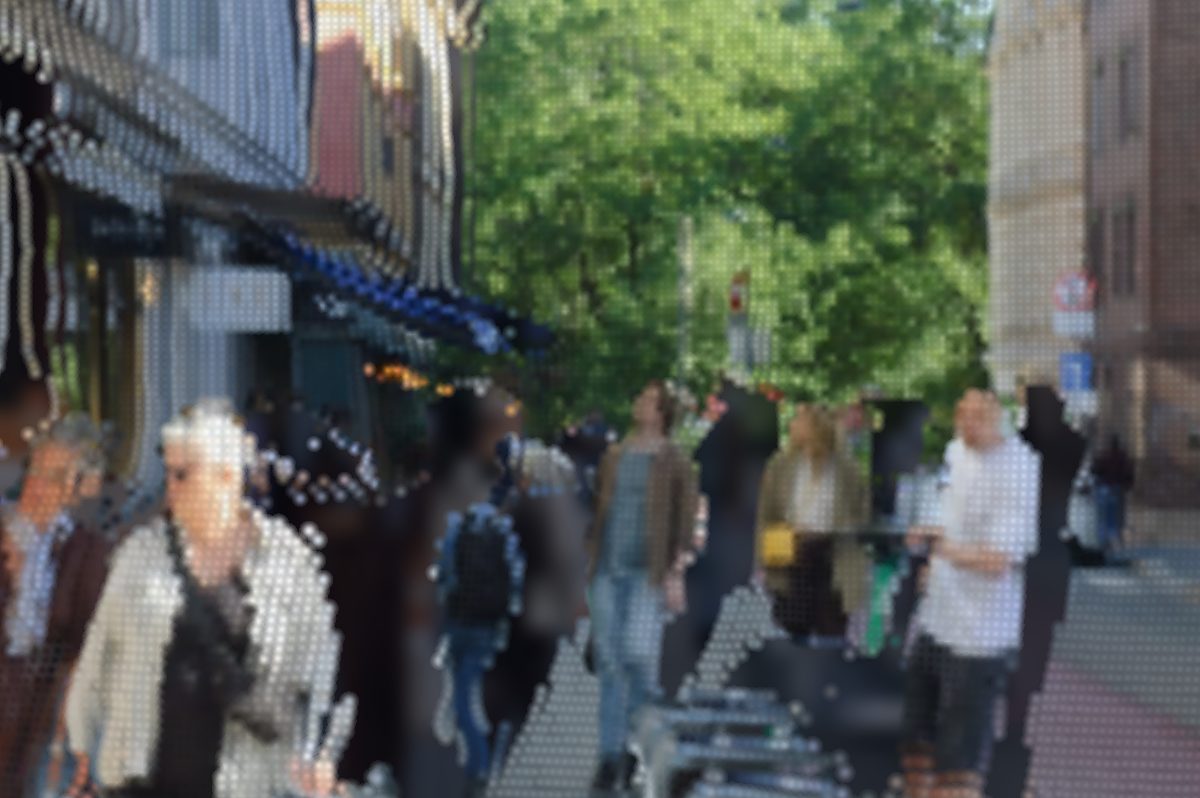 beforeafter
Free · no sign-up · runs in your browser — your photo is never uploaded.
This builds it from one clip, on your phone or laptop. A depth model works out how far away every part of every frame is, each few pixels becomes a soft splat at that depth, and a camera flies through the result — dollying in past the nearest things, swaying, turning. What was flat comes apart into layers; what was hidden behind someone opens up as a ghost.
Nothing uploads. The depth model downloads once, about 27 MB, the first time you use the look, and runs in your browser after that.
How to use it
- Open the tool and drop in a clip — or a photo, which gets one moment of the flight.
- Pick Splat Flythrough from the Video tab. The scene builds while you watch; a short clip takes a few seconds.
- Flight is how far the camera travels, Depth how deep the scene is, Splats how big and soft each blob is.
- Export an MP4 — the flight loops once over the clip, so it loops cleanly.
Tips
- Depth is the whole effect, so shots with something near and something far — a face against a street, a hand in front of a sky — come apart the most.
- Push Flight up to fly through the nearest thing in the frame; keep it low for a slow 3D-photo drift.
- Stack it with VHS or Datamosh Video for a splat scene that is falling apart in two ways at once.
Shot with Splat Flythrough on Explore
Cameras built on it — open one and it loads onto your own photo.
FAQ
Is this real Gaussian splatting?
The rendering is: the picture is drawn as Gaussian splats, each placed in 3D at its depth. The scene is not trained the way a research splat is — that needs many views and a GPU server. Instead a depth model estimates the 3D shape of every frame on your device, which is what makes it instant and private.
Do I need a GPU or an app?
No. It runs in the browser — WebGPU where your device has it, plain WebAssembly where it does not — and on iPhone in the liminal app.
Does my video upload anywhere?
No. The depth model downloads to you; your clip never leaves your device unless you post it.
Can I do it to a photo?
Yes. A photo becomes one frame of the flight — a 3D still with the layers pulled apart.